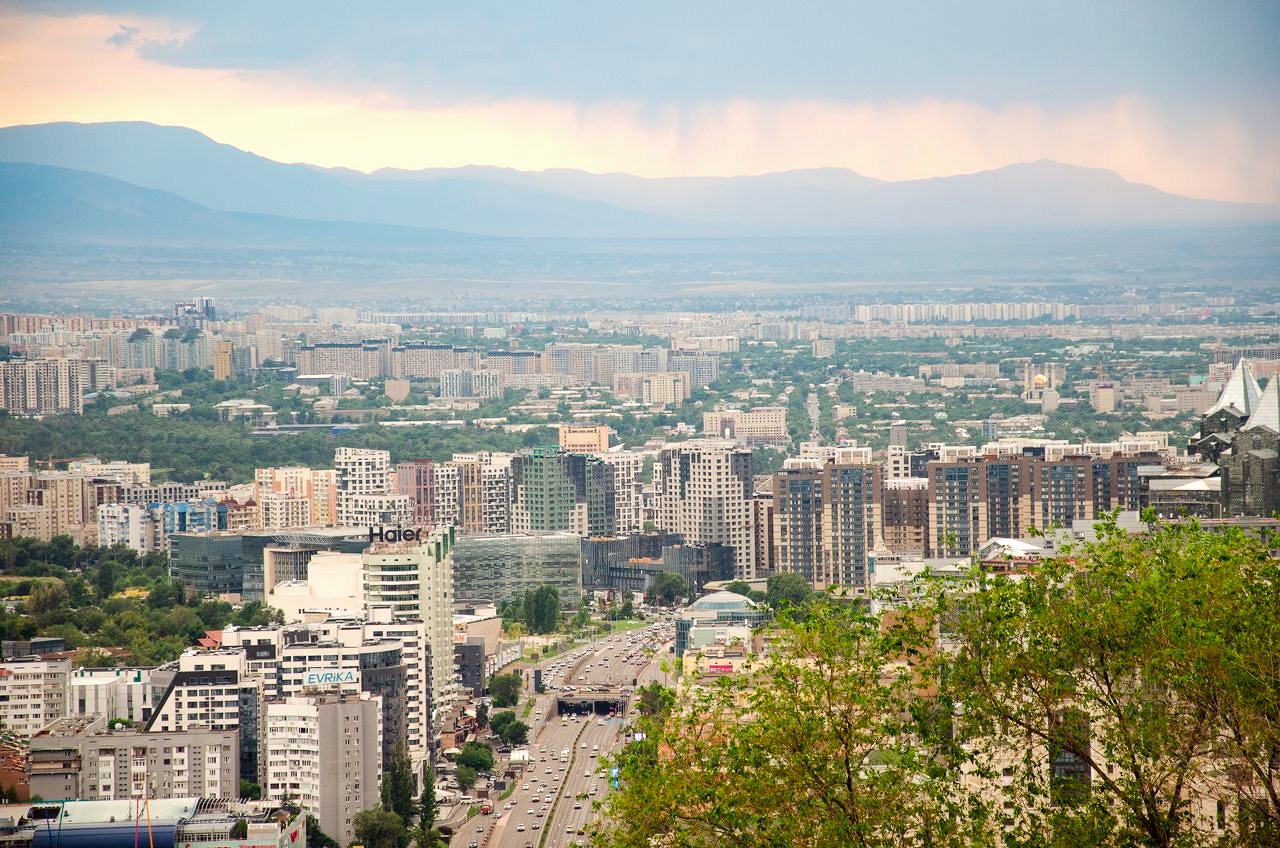
 Almaty is the largest city, trade, and economic center of Kazakhstan. The population is more than 2 370 000 people. Almaty was called Zailiyskoe (1854) and later Verny when it first started as a fort. Later, it was named Alma-Ata (1921). Finally, after Kazakhstan became independent, it was given its official name, Almaty (1993). Almaty is translated from the Kazakh language as “father of apples”; it is the perfect place for fruit growing, as there are many fertile lands around Almaty. Due to its location at the foot of the Tian-Shan Mountains, Almaty was known as one of the most beautiful cities of the former USSR.
The flora and fauna of Zailiysky Alatau are rich and diverse. The environs of Almaty are part of Ili-Alatau National Park, on the territory of which there are nature wildlife preserves. Many rare birds and animals living here are listed in the Red Book of Kazakhstan. Among them is a snow leopard (ounce), which today is the symbol of Almaty.
At the moment, Almaty is the scientific, cultural, historical, industrial, and financial center of the country. On the 1st of July, 1998, the Law on the special status of the city was passed. Almaty is unofficially called the "South Capital"
The city is multiethnic: the Kazakhs (73.7 %), Russians (9.4%), Uzbeks (0.4%), Uighurs (7.7), Tatars (0.5 %), Germans (0.6%), Ukrainians (0.5 %), and others (7.2%). Almaty's diverse population contributes to its cosmopolitan and multilingual character. The Russian and Kazakh languages are widely spoken in the city.
Architecture and sightseeing
Almaty is a sunny, cozy, and green city with wide streets, beautiful buildings, numerous parks, public gardens, and fountains. The luxuriant green attire and the magnificent panorama of the mountains make Almaty unlike any other city. Today there are more than 120 fountains, 61 of which are municipally owned. The fountains, with their extensive canal network, play a major role for Almaty; together they form a single complex of ponds and streams throughout the city.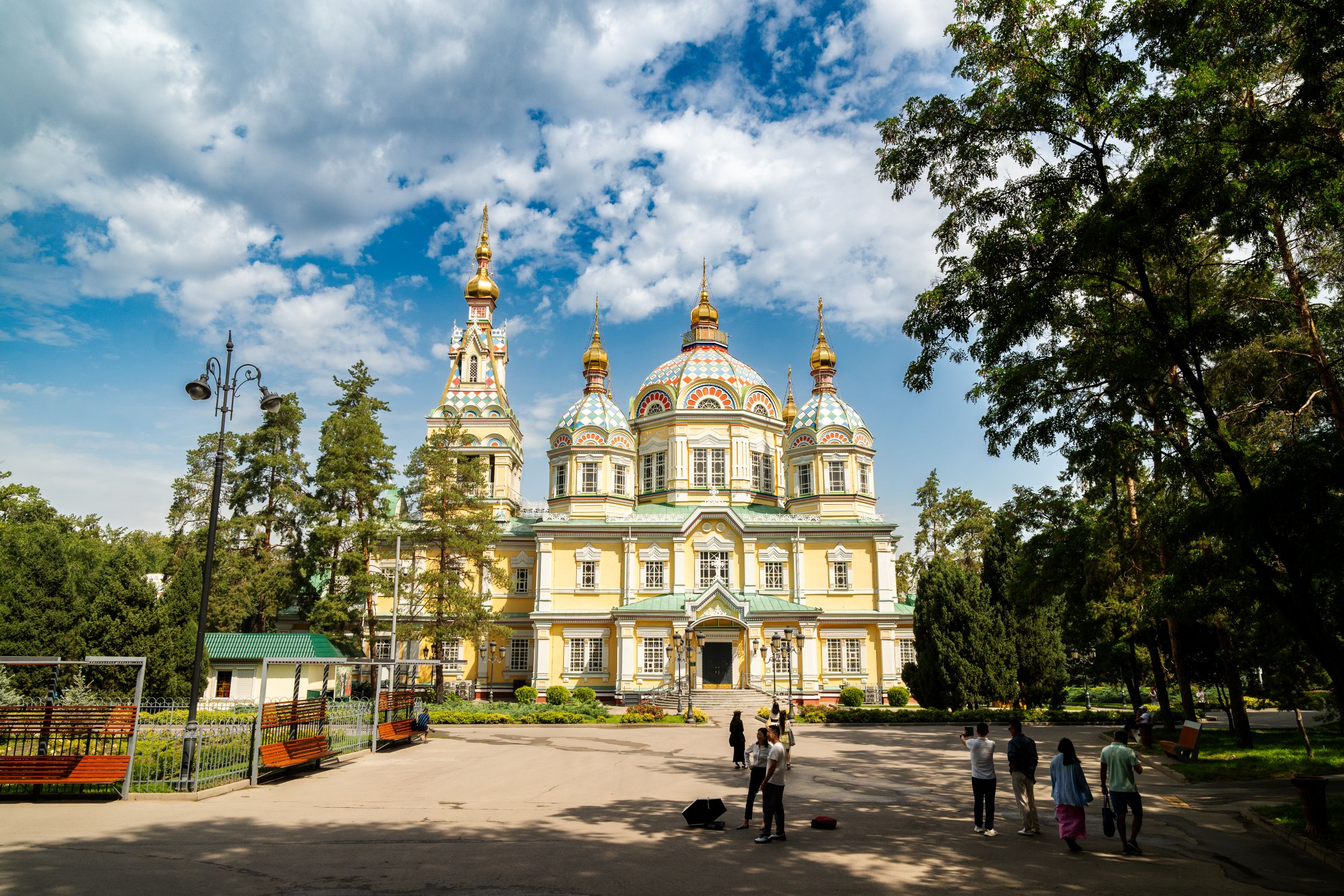
The Ascension Cathedral
The Ascension Cathedral in Almaty is a unique, earthquake-proof engineering construction with a height of 56 meters, built by the architect K. A. Borisoglebsky and the engineer A. P. Zenkov in 1907. The Cathedral was built from blue Tian-Shan spruce according to the design project by Pavel Gurde.
A. P. Zenkov created new methods of building in earthquake-prone zones, thanks to which in 1911 the Cathedral withstood a magnitude 10 earthquake.
The walls of the church were painted by the local artist N. Khludov. During the Soviet period, there was a local history museum in this building. In May 1995, the building returned to the Almaty and Semipalatinsk diocese of the Russian Orthodox Church. In 1997, after two years of restoration work, the religious services were resumed in the church.
There is a widespread opinion that the church was built without any nails, but it is a myth.
 TV tower
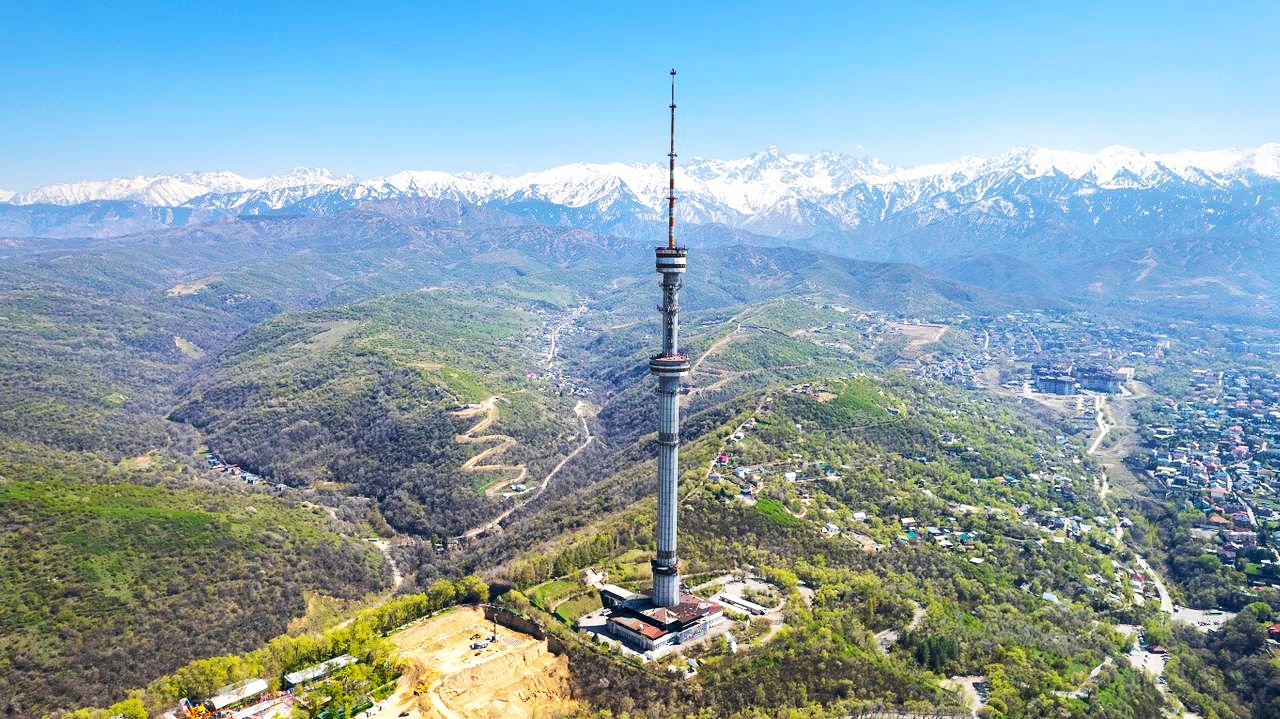
The TV tower is located on the Kok-Tobe top at an altitude of 1,000 meters above sea level. It is the highest construction in Almaty. Its height is almost 371.5 meters (1,130 feet) above sea level. The base of the tower is a reinforced concrete foundation in the form of a three-story sectional basement. The body of the tower is a metallic stepped dioctahedron with a diameter of 18 meters at the base, 13 and 9 meters at the maintenance service locations at a height of 146 and 252 meters. The tower was built taking the mountain environment into account, and it can withstand earthquakes up to magnitude 10. The TV tower is a complex radio and television transmission station, and it is closed to tourists. The tower is visible almost from any point in the city, because it is illuminated with powerful searchlights at dark.
High-mountain skating rink "Medeo": The sports complex "Medeo" was built in 1972 in the gorge of the same name, 15 kilometers from the city. "Medeo" was called the “factory of records” because 126 world records were established on this high-mountain skating rink over 33 years. The unique feature of the skating rink, which is located at a height of 1700 meters, is that it is situated in rarefied air and has high-quality ice. This is possible due to pure mountain water without admixtures of salt. Above the sports complex, an anti-mudslide protection dam and the ski resort "Chimbulak" are located. In the ‘90s of the XX century, the sports complex "Medeo" was the venue for the international music festival Voice of Asia (Asia Dauisy). Now the complex "Medeo" and the high-mountain ski center "Chimbulak" have been reconstructed.
There are many monuments dedicated to various historical statesmen in the city.
In 2006, Almaty got the right to hold the Winter Asian Games, and in 2011, it co-hosted them with Astana. An entire ensemble of modern arenas for the Winter Asian Games was built in Almaty. They are: an ice stadium with a 400-meter track, ski and biathlon stadiums, a new ski resort, K-95- and K-125-meter ski jumps with stands for 20,000 spectators, and a bobsleigh track. Additionally, Kazakhstan will officially host the 10th Asian Winter Games in 2029 in Almaty.

 Central Asia & Caucasus DMC